
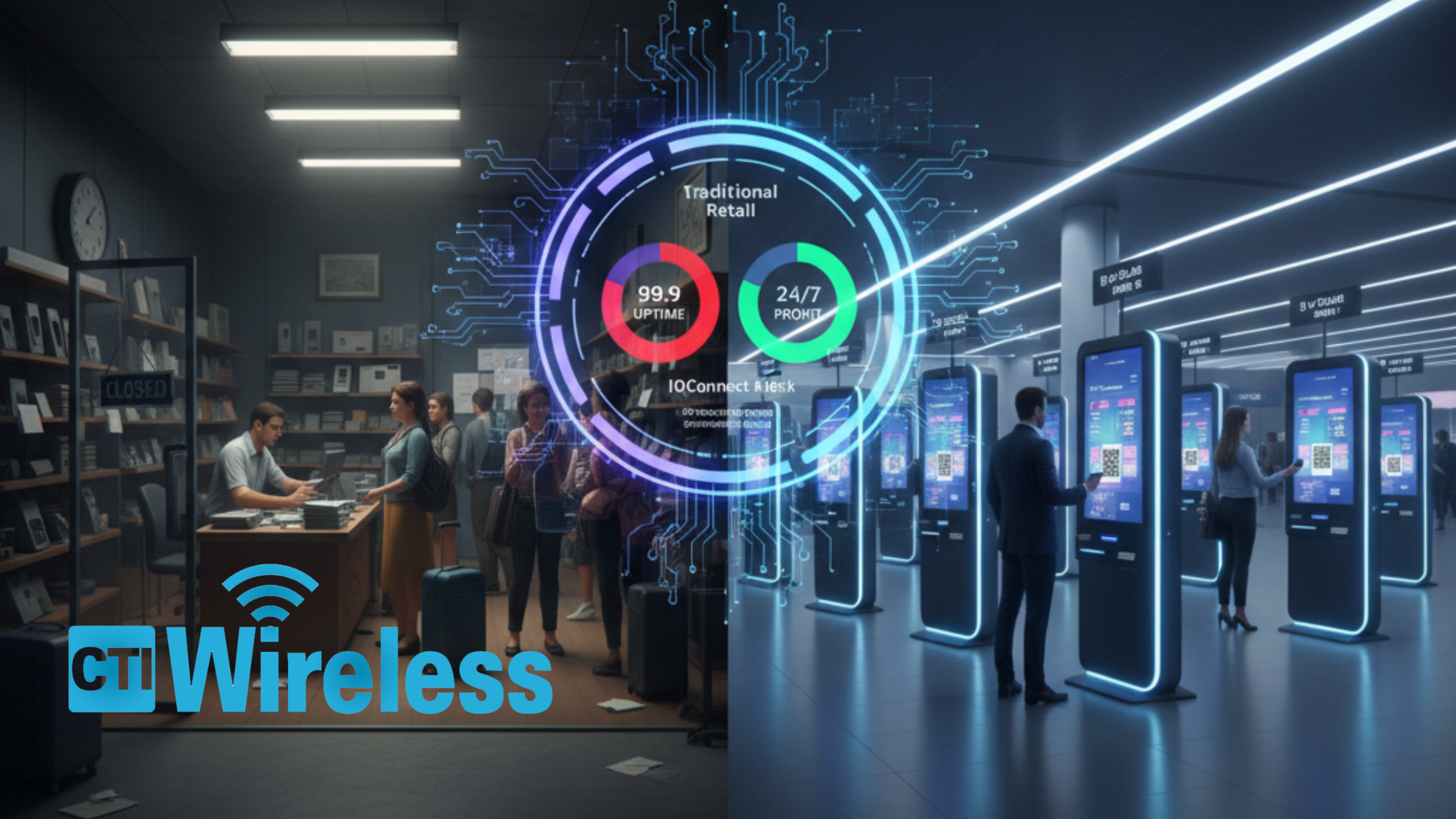
The Economics of Autonomous Telecom Retail: Kiosks vs. Traditional Stores
As we enter 2026, the retail landscape for telecommunications has reached a tipping point. The "Old Guard" of expansive, staff-heavy storefronts is being challenged by a leaner, more efficient model: Autonomous Smart Retail. For operators and MVNOs, the question is no longer if they should automate, but how fast they can deploy.
When comparing the economics of a traditional retail footprint against an IQConnect Smart Kiosk, the financial model points toward a more compact and automated approach.
The OpEx Divide: Where Traditional Retail Fails
Traditional stores carry "Legacy Weight"—costs that do not directly contribute to the customer experience but drain the bottom line.
- Labor Costs: In 2026, rising wages and training requirements make human-led retail one of the highest expenses for carriers.
- Real Estate: High-traffic locations like Tier-1 airports or luxury malls demand premium square footage prices that a 500-square-foot store can rarely justify.
- Shrinkage and Error: Human error in KYC (Know Your Customer) and cash handling can create additional operational losses in traditional retail environments.
By contrast, an IQConnect Kiosk occupies less than 15 square feet and requires zero on-site staff. By shifting toward automated retail, operators can reduce many of the recurring expenses associated with traditional storefronts.
The "Always-On" Advantage
Traditional stores are limited by the clock. In an era of global travel, a store that closes at 9:00 PM can miss potential revenue from international passengers landing late at night.
IQConnect kiosks provide 24/7 sales capability. They don't take breaks, they don't call in sick, and they can offer a consistent, multilingual experience to every user.
Speed of Deployment: Scaling at 2026 Velocity
Opening a new physical store requires permits, construction, equipment, and hiring. A smart kiosk offers a significantly more agile deployment model.
This flexibility allows Master Agents and Operators to respond more quickly to demand. If a new flight route opens, a high-traffic venue becomes available, or a major event creates temporary demand, kiosks can provide an alternative to establishing a permanent retail location.
Data-Driven Decision Making
Traditional retail operations often depend on periodic reporting. An IQConnect kiosk can provide operators with centralized operational data.
Through a centralized dashboard, operators can monitor:
- Heat maps of purchase times.
- Conversion funnels to identify where users drop off.
- Inventory levels for physical SIMs or hardware accessories.
Access to this data can help operators identify demand patterns, optimize inventory, and make better deployment decisions.
Conclusion: Future-Proofing Your Retail Strategy
Autonomous telecom retail offers operators an alternative to the cost and operational complexity of traditional storefronts.
A smaller physical footprint, extended operating hours, centralized management, and faster deployment can make smart kiosks particularly relevant for airports, malls, transportation hubs, hospitality environments, and other high-traffic locations.
For operators evaluating their 2026 retail strategy, the key question is no longer simply how many stores to open. It is how to build a retail footprint that can scale efficiently while meeting customers where connectivity is needed.
| Feature | Traditional Retail Store | IQConnect Smart Kiosk |
|---|---|---|
| Setup Time | Months | Faster deployment |
| Monthly OpEx | High (Rent + Utilities + Labor) | Lower operating overhead |
| Operating Hours | Limited daily hours | 24/7 availability |
| Labor Costs | Requires on-site staff | No dedicated on-site staff |
| Space Required | Large retail footprint | Compact footprint |
| KYC Process | Staff-assisted verification | Automated verification |
| Scalability | Higher cost per new location | Rapid multi-site rollout |
FAQs
How can telecom kiosks improve retail ROI?
Telecom kiosks can reduce recurring expenses associated with staffing and large retail footprints while extending service availability beyond traditional store hours. Actual ROI depends on deployment costs, transaction volume, location, and product mix.
Can kiosks support KYC compliance?
IQConnect kiosks can incorporate automated identity verification and biometric technologies into the customer onboarding process. Specific compliance requirements depend on the market and applicable regulations.
Can I manage multiple carrier brands through a single kiosk?
The IQConnect platform is designed to support multi-carrier telecom operations through a centralized interface.