
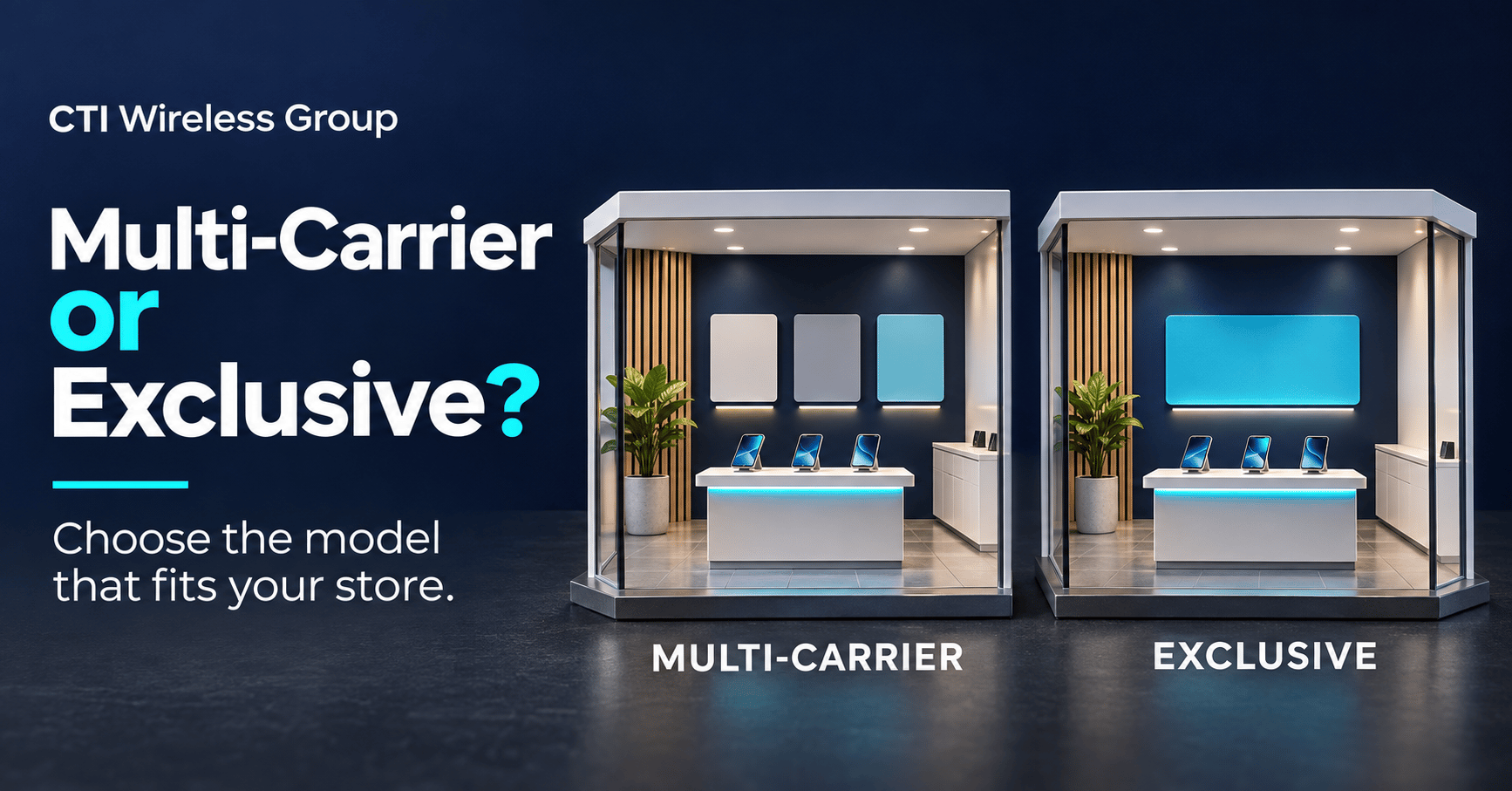
Multi-Carrier Wireless Dealer or Exclusive Store: Which Fits?
A multi-carrier wireless dealer offers services from more than one approved wireless brand, while an exclusive store operates within a more restricted brand relationship. Choosing between them means comparing the customer demand you can serve with the agreements, training, inventory, and operating costs each model requires.
At CTI Wireless Group, we work with businesses evaluating wireless dealer opportunities. The useful question is which setup your location can operate well. A broader offering can create more choices for customers; a focused offering can simplify some tasks. Neither guarantees higher profit.
Understand What Each Dealer Model Actually Covers
A Multi-Carrier Store
A multi-carrier store sells more than one wireless brand under the approvals and agreements that apply to its business. The retailer may compare available programs for customers with different budgets, devices, and service needs. Each additional offering brings its own rules, activation steps, and support responsibilities.
Multiple brands also do not automatically mean multiple independent networks. Understand the service behind each offering and verify the coverage and device requirements relevant to the customer. A larger brand list is not a substitute for a suitable recommendation.
An Exclusive or Single-Brand Store
A single-brand store concentrates its wireless offering on one brand. An exclusive agreement can restrict which competing services the location may sell, but the exact scope comes from the contract. Confirm how its conditions apply to signage, accessories, other services, online sales, and additional locations.
Do not assume that a focused store must follow every restriction described in another dealer’s experience. Equally, do not assume that an independent storefront is free of program conditions. Review the proposal for your own location.
Compare the Operational Trade-Offs
Customer Choice and Brand Positioning
A broader offering may help a store answer requests that one approved program cannot satisfy. It also requires staff to explain differences accurately. A focused store can build its sales process around a familiar offering, but it needs a plan for customers whose needs fall outside that program.
Use recorded inquiries to evaluate the trade-off. Identify which requests your store can fulfill today, which it cannot, and why. Distinguish a missing brand from other barriers, such as device incompatibility, customer budget, or unavailable service.
Compensation and Revenue Concentration
Compare the current written compensation terms of the programs available under each model. Look at qualifying transactions, calculation bases, later conditions, settlement, and adjustments. Also identify the costs your store funds to complete the sale.
Several programs can spread activity across brands, but the value depends on actual sales and their contribution. Adding a rarely used program may create administrative work without materially changing revenue concentration. Track earned compensation and costs by program before treating a larger portfolio as financial protection.
Inventory and Working Cash
A broader offering may require different SIM materials, compatible devices, approved displays, or other program-specific supplies. Ask what each program requires and estimate the cash needed to keep those items available. Check whether devices can serve multiple approved uses before treating inventory as interchangeable.
For a focused model, review the proposed product range and any purchasing obligations. For either approach, tie orders to demonstrated demand and lead times. Avoid making a large opening purchase solely because an assortment looks complete.
Training and Transaction Accuracy
Every additional workflow needs a staff member who can perform it correctly. Prepare a short reference for the approved plans, eligibility checks, activation steps, and escalation contact. Assign responsibility for updating that information when a program changes.
A focused store still needs complete training. The comparison is the amount and variety of work required at your location, not whether one model eliminates operational errors. Check how new staff will learn the process and how managers will identify recurring mistakes.
Support and Reporting
Confirm where activation, payment, inventory, and compensation questions go for each offering. Ask whether your team will use separate systems and how records connect across them. A common business relationship does not establish that every transaction shares one portal or settlement process.
Test the handoff between employees before launch. When a customer returns during another shift, the next representative should be able to identify the original program, locate the transaction, and route the question correctly. Assign a contact path for each program instead of assuming every issue goes to the same team.
Read the Agreement Before Expanding Your Offering
Review exclusivity, territory, location approval, branding, channel, purchasing, performance, renewal, and termination conditions. Ask which documents govern the relationship and how changes are communicated. Do not advertise another service until its approval and compatibility with existing obligations are confirmed.
If you already operate a store, identify whether the proposed change affects its current authorization. Adding a program, changing a storefront, or opening another location can require a separate conversation. Keep written approvals and current terms with your business records.
When a Focused Store May Fit Your Business
A focused offering may suit a location where documented demand concentrates on one available program and staff can support its requirements consistently. It can also make sense when the approved brand relationship fits your intended storefront and operating plan.
Test that choice against the requests you currently miss. If another program would address a recurring customer need, compare its likely contribution with the additional cost and work. Customer choice matters when your store can deliver the service reliably and within its agreements.
When a Multi-Carrier Wireless Dealer Model May Fit
A broader offering may suit a store serving several recurring customer needs that its current program cannot meet. The case becomes stronger when staff can learn the extra workflows, the required inventory is affordable, and the agreements permit the proposed combination.
Start with a specific reason to add each program. Define the customer request it addresses, the sales your team expects to process, and the records needed to evaluate results. An addition should have an operating purpose beyond increasing the number of logos in the window.
Test the Model Before Committing More Resources
Once the required approvals are in place, review an initial group of completed transactions before expanding the rollout. Use the same measures across the programs you evaluate:
- Customer fit: Which documented service requests can the store fulfill?
- Transaction quality: Which eligible sales complete correctly, and which need rework?
- Staff workload: How much selling, training, and follow-up time does the offering require?
- Contribution: What earned compensation remains after the store’s related costs and adjustments?
Review unresolved support cases alongside sales totals. Keep separate records for programs with different payment conditions so future compensation does not obscure cash already received. Use your baseline to decide what to continue, correct, or expand.
Discuss Your Dealer Model With CTI Wireless Group
Our opportunities include AT&T Prepaid, Cricket Wireless, T-Mobile Prepaid, and MobileX. Review the matching program pages, then ask us to confirm the offerings and sales channels relevant to your business. Approval and agreement conditions determine what your store can offer.
Explore the businesses we serve to see how your store fits our dealer opportunities. When you contact us, describe your location, current approvals, customer demand, staffing, and the model you are considering.
Contact CTI Wireless Group about your dealer model to discuss your next step.
FAQs About Multi-Carrier and Exclusive Wireless Dealers
What Is a Multi-Carrier Wireless Dealer?
It is a retailer authorized to sell services from more than one wireless brand. The available combination depends on the approvals and agreements for the business. Each offering can have its own activation, inventory, support, and compensation requirements.
Does a Multi-Carrier Store Always Earn More?
No. Results depend on customer demand, eligible sales, compensation terms, staff capability, inventory, and operating costs. Compare the contribution retained from completed transactions and the work required to support them. More programs do not establish higher profit.
Can an Exclusive Dealer Add Another Wireless Brand?
That depends on the written agreement and any required approvals. Review exclusivity, branding, channel, and location conditions with the relevant program team before advertising or selling another service. Do not assume permission based on what another retailer offers.
Is a Multi-Carrier Model Suitable for a New Store?
It can be, if the business qualifies for the proposed programs and can support their requirements. A new store should confirm customer demand, training, account access, inventory needs, and support procedures before adding several workflows at once.
What Should I Prepare Before Discussing a Dealer Model With CTI?
Prepare your business location, store format, current provider approvals, programs of interest, staffing plan, and recurring customer requests. Include questions about permitted program combinations, onboarding, compensation, inventory, reporting, and support so the discussion addresses the proposed operation.