
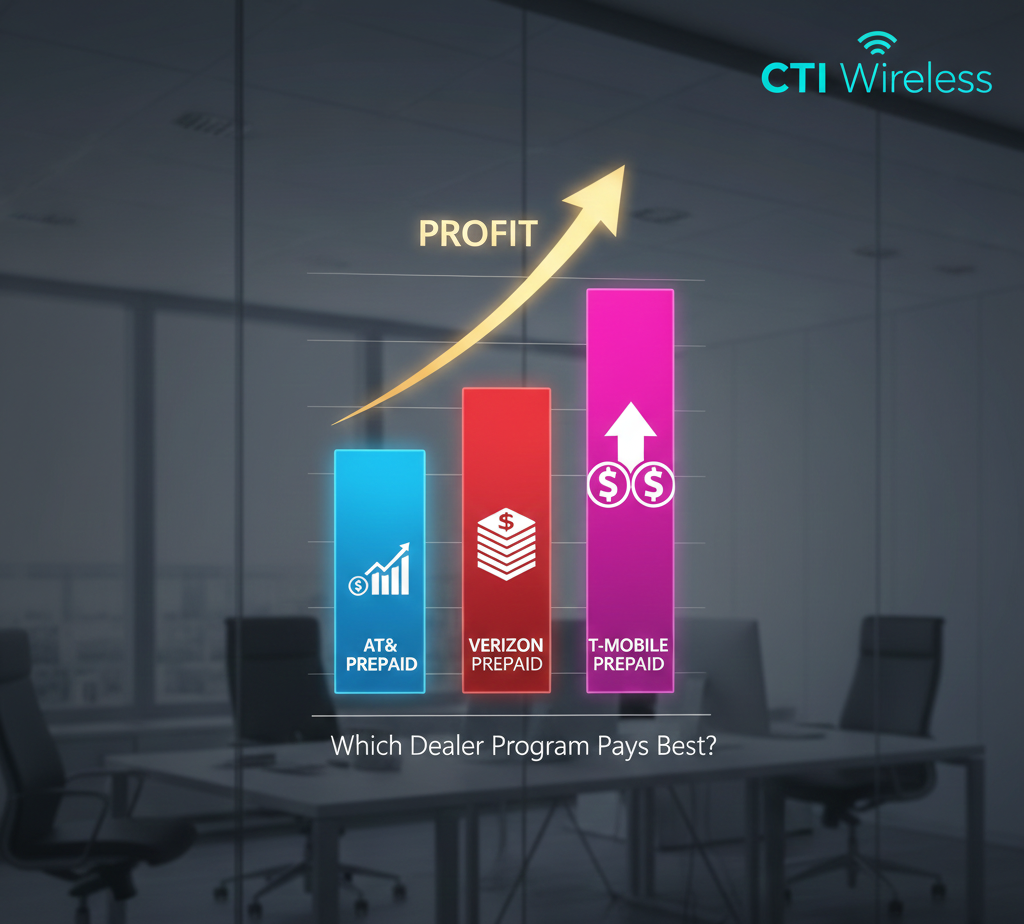
The Ultimate Carrier Comparison: AT&T, Verizon, or T-Mobile Prepaid—Which Program Maximizes Your Store’s Profit?
If you run a wireless retail store, you know that shelf space is expensive. Every square foot of your shop needs to generate revenue. When a customer walks in asking for a SIM card or a top-up, the logo on your wall determines two things: how likely they are to buy, and how much money lands in your bank account at the end of the month.
The debate is endless: AT&T Prepaid, Verizon Prepaid, or T-Mobile Prepaid?
As America's Most Trusted Master Agent, CTI Wireless has seen the commission structures, the dealer portals, and the real-world results of thousands of retailers. We aren't just guessing; we see the data.
This guide isn't about which carrier has faster 5G for watching YouTube. It’s about which carrier is the best business partner for you. We’re breaking down the "Big Three" to help you decide where to focus your efforts.
The Reality of Prepaid Commissions
Before we dive into the specific carriers, let’s address the elephant in the room. If you search for "exact commission sheets" online, you won't find them. That’s because carriers adjust their SPIFFs (Sales Performance Incentive Funds) and residual models quarterly or even monthly based on market aggression.
However, the philosophy of how they pay dealers remains consistent. To make money in this industry, you need a Master Agent Wireless partner who fights for your margins and ensures those payouts are accurate.
Here is how the giants stack up against each other.
1. AT&T Prepaid: The Brand Authority
For many dealers, becoming an AT&T Prepaid dealer is the safe, reliable bet. AT&T has massive brand equity. When a customer sees that blue globe, they assume the service will work. This lowers the barrier to sale—you don't have to spend 20 minutes convincing the customer the network is good.
The Dealer Pros:
-
High Retention: AT&T Prepaid customers tend to be "stickier." They don't switch carriers every month. This is crucial if your compensation model relies on the 2nd and 3rd-month refill (airtime margin).
-
Solid Handset Lineup: AT&T often provides excellent mid-range devices that are easy to move.
-
Consistent SPIFFs: While they may not always have the wildest "doorbuster" payouts, their commission structure is stable. You know what you are getting.
The Trade-off:
Because the brand sells itself, the aggressive "sign-on bonuses" might sometimes be lower than a challenger brand. However, the lower churn rate often means higher long-term value per customer.
2. Verizon Prepaid: The Quality Premium
Verizon has built its reputation on having the best coverage map in rural and difficult areas. If your store is located in an area where other signals drop, Verizon Prepaid is not just an option; it's a necessity.
The Dealer Pros:
-
Higher ARPU (Average Revenue Per User): Verizon customers are often willing to pay for higher-tier unlimited plans. A $60 or $70 plan sale generates a significantly higher commission than a stripped-down $30 talk-and-text plan.
-
BYOD Opportunities: Verizon pushes "Bring Your Own Device" heavily. For a dealer, this is gold. You don't have to float the cost of phone inventory; you just sell the SIM and the airtime, keeping your overhead low.
The Trade-off:
Verizon's prepaid ecosystem can sometimes be stricter regarding handset eligibility. You need a Master Agent who understands the nuances of the Verizon Prepaid portal to ensure your activations go through smoothly.
3. T-Mobile Prepaid: The Volume King
T-Mobile (and its associated brands) is known for being the "Un-carrier." In the prepaid space, they are incredibly aggressive with marketing. If your store is in a high-traffic urban center, T-Mobile Prepaid can drive serious volume.
The Dealer Pros:
-
Aggressive Promos: T-Mobile is known for "4 lines for $X" deals that bring families into the store. Activating a family plan (3-4 lines at once) is the fastest way to hit your monthly volume tiers.
-
Speed: In many metro areas, their 5G speeds are currently outpacing the competition, which is a great selling point for data-hungry younger demographics.
The Trade-off:
The prepaid market for T-Mobile is highly competitive. There might be another shop down the street selling the same thing. This is where your customer service and your relationship with your Master Agent make the difference.
Why You Need a Master Agent (Don't Go Direct)
You might be thinking, "Can I just contract directly with these carriers?"
Technically, maybe. Realistically? It’s a nightmare for an independent store owner. Carriers prefer dealing with large aggregators—Master Agents—rather than thousands of individual shops.
Here is why partnering with CTI Wireless beats trying to go it alone:
1. Consolidated Buying Power
We represent thousands of doors. This gives us leverage. We negotiate better tiers and exclusive spiffs that a single store could never get on their own. We pass those benefits down to you.
2. One Portal, One Check
Imagine having to log into three different systems to reconcile your commissions, and chasing three different support teams when a payment is missing. At CTI Wireless, we streamline this. We offer accurate and timely commission payouts. You sell; we handle the backend administrative headache.
3. Inventory Finance
Carriers expect you to buy phones upfront. That ties up your cash flow. CTI Wireless offers unique Finance solutions for our partners. We help you stock your shelves with the latest devices without draining your operating capital. This is a game-changer that direct carrier relationships rarely offer to small dealers.
The "Wild Card" Options: MobileX and MVNOs
While the Big Three are essential, the smartest dealers are diversifying. Have you looked at MobileX? As a CTI partner, you get access to disruptors like MobileX, Light Mobile, and others.
These MVNOs (Mobile Virtual Network Operators) often offer:
-
Higher Margins: Because they have lower overhead, they can pass more profit to the dealer.
-
Niche Appeal: Perfect for customers who want customizable plans rather than "one size fits all."
Internal Tip: Read our guide on MobileX Opportunities to see why this might be the most profitable square foot in your store this year.
The Verdict: Who Pays Best?
There is no single winner because it depends on your business model:
-
Choose AT&T Prepaid if you want stability, lower churn, and a brand that requires little explanation.
-
Choose Verizon Prepaid if you sell to high-value customers or are in a rural market where coverage is king.
-
Choose T-Mobile Prepaid if you are in a dense city and want to drive high-volume family plan activations.
The real winner? The dealer who carries a mix. By becoming a multi-carrier dealer with CTI Wireless, you never have to walk a customer out the door because you didn't have the network they wanted.
Ready to Maximize Your Margins?
Stop leaving money on the table with subpar commission splits or late payments. Join America's Most Trusted Master Agent.
Whether you need to stock up on SIMs, get financing for new inventory, or add a new carrier to your lineup, CTI Wireless is your growth partner in Miami and across the USA.
Frequently Asked Questions (FAQs)
Q: What is a Master Agent in the wireless industry? A: A Master Agent acts as an intermediary between the major wireless carriers (like AT&T, Verizon) and independent retailers. We aggregate volume to negotiate better commissions, provide marketing support, and handle administrative duties for dealers.
Q: Can I sell multiple carriers in one store? A: Yes! In fact, we recommend it. A "multi-carrier" strategy ensures you have a plan for every customer who walks in, regardless of their budget or coverage needs. CTI Wireless supports AT&T, Verizon, Cricket, T-Mobile, and more.
Q: How often are prepaid commissions paid? A: This varies by program, but CTI Wireless prides itself on timely payouts. Generally, SPIFFs (activation bonuses) are paid quickly, while residuals (airtime percentages) are calculated monthly. We provide transparent reporting so you always know what you are owed.
Q: Do I need good credit to open a wireless store? A: While opening a store requires capital, CTI Wireless offers Finance options to help with inventory and startup costs. We focus on your business potential, not just your personal credit score.