
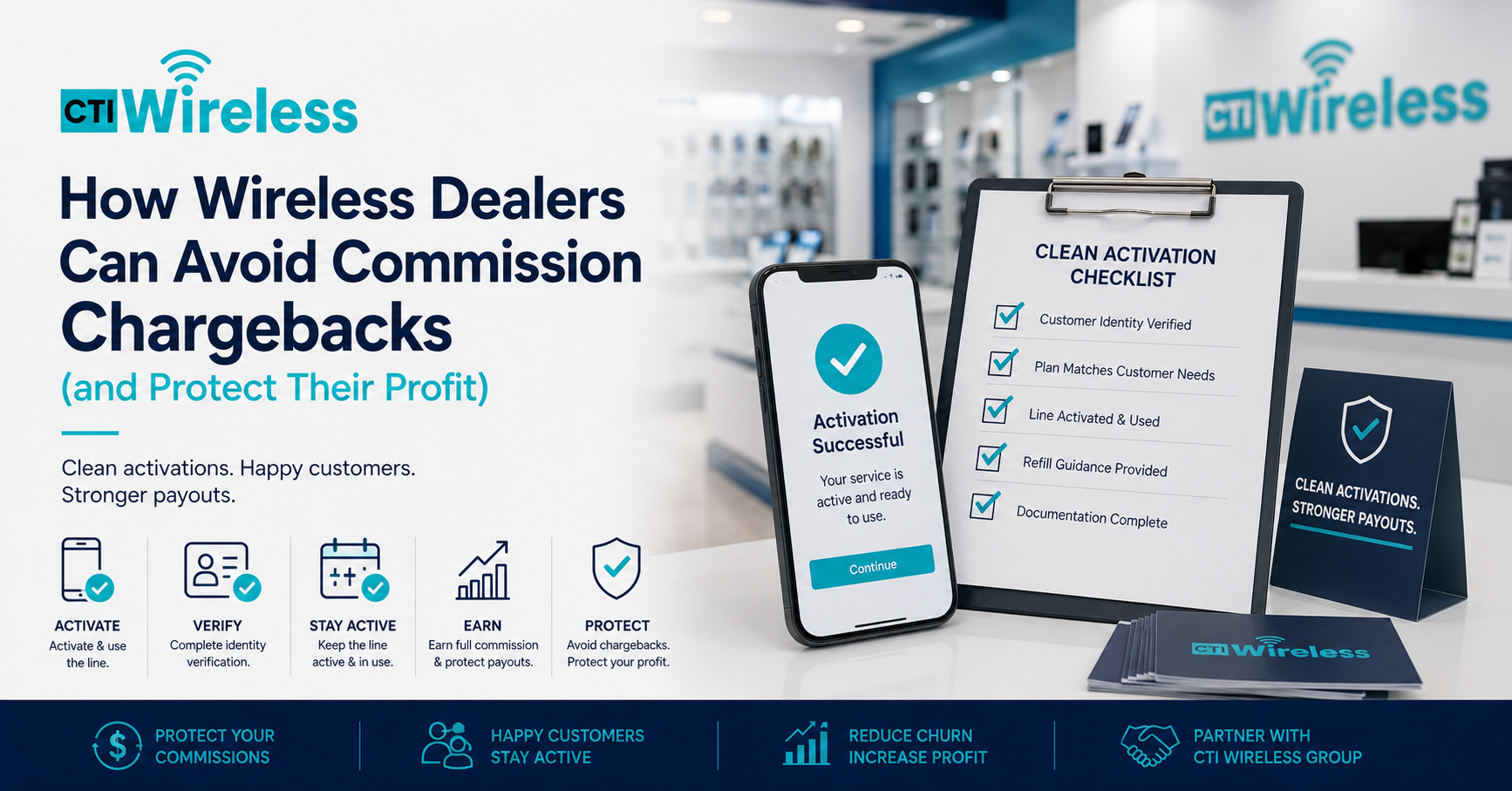
How Wireless Dealers Can Avoid Commission Chargebacks (and Protect Their Profit)
Most wireless dealers measure success by activations. But the number that actually lands in your bank account is activations minus chargebacks. A chargeback is the quiet profit killer in prepaid retail: you make the sale, you book the commission, and weeks later the carrier claws it back because the activation didn't meet the rules.
If your store is seeing commissions get reduced after the fact — or you simply want to protect your margins before it becomes a problem — this guide breaks down why chargebacks happen and how to prevent them. At CTI Wireless Group, we help dealers build clean, compliant activation processes so more of the commission you earn is commission you keep.
What a Commission Chargeback Actually Is
A chargeback is when a carrier reverses a commission it already paid (or was scheduled to pay) because the activation didn't hold up. In prepaid wireless, compensation is usually tied not just to the activation itself, but to the line actually being used and staying active over the first months of service.
That means a single bad activation can cost you twice: you lose the upfront commission and the residual or month-two/month-three compensation you were counting on. Across a busy month, unmanaged chargebacks can turn a strong activation report into a disappointing payout.
Why Chargebacks Happen: The Most Common Triggers
Chargebacks are rarely random. They almost always trace back to a handful of avoidable issues.
The line never activated or was never used on the network
This is the single most common cause. Many carrier compensation structures only pay (and let you keep) commission when the device actually installs and shows real usage on the network. If the SIM is sold but never activated, or the customer walks out and never powers up the line, the carrier can reverse the commission. As an example, Cricket's dealer terms state that chargebacks apply to compensation tied to activations that do not install with usage on the network.
Fraudulent or low-quality activations
Activations created to hit a volume target — fake names, bulk self-activations, lines nobody intends to use — are the fastest route to chargebacks and, worse, to losing your dealer standing. Carriers monitor for this, and the compensation gets reversed when it's flagged. A structured, properly completed carrier application and onboarding with the right paperwork from the start is the first defense against this kind of reversal.
Early churn or non-payment of later months
Because prepaid compensation often pays out over the first two or three months, a customer who doesn't refill or who cancels early can trigger a partial chargeback. The activation was real, but it didn't last long enough to earn the full payout.
KYC and identity problems
If customer identity verification is incomplete or inconsistent, the activation can be reversed during review. Clean, accurate customer information at the point of sale protects the commission.
Port-outs and quick deactivations
A line that ports away to another carrier or gets deactivated shortly after activation can fall inside the carrier's holdback window and reverse the commission.
The Hidden Cost of “Junk” Activations
It's tempting to think a weak activation is still “free money” — you got paid something. In a prepaid model, the opposite is usually true. A line that activates but never gets used can cost you the commission later, while a customer who genuinely needs the service refills, stays active, and earns you the full multi-month compensation.
Dealer profitability isn't about closing more sales. It's about closing the right sales — clean activations from customers who keep using the service.
How to Prevent Chargebacks: A Practical Playbook
The good news is that chargebacks are highly preventable with a disciplined process at the counter.
1. Sell to a real need, not a quota
Match the customer to a plan that fits how they actually use their phone. A customer on the right plan is far more likely to refill and stay active — which is exactly what protects your residual compensation.
2. Make sure the line activates and is used before the customer leaves
Don't treat the sale as done when payment clears. Confirm the device is provisioned, the line is live, and the customer can make a call or use data before they walk out. First-use on the network is often what locks in your commission.
3. Complete identity verification correctly, every time
Take the extra minute to enter accurate, consistent customer information. Sloppy or mismatched data is an easy reason for a carrier to reverse a commission during review.
4. Set the customer up to refill
Walk the customer through how and when to make their next payment, and the benefits of staying active. Plans built around no-contract value — like Cricket Wireless or AT&T Prepaid — make it easier for customers to keep refilling. Reducing early churn directly reduces month-two and month-three chargebacks.
5. Train staff to avoid shortcuts
Every rep should understand that a clean activation is worth more than a fast one. Build it into onboarding: no fake or bulk activations, no skipping verification, no rushing the first-use step.
6. Track the holdback window
Know how long each carrier's compensation is at risk after activation, and watch for early deactivations or port-outs in that period so you can spot patterns and coach your team.
Be Extra Careful With Multiline and Family Activations
Multiline activations are great for revenue, but they also multiply chargeback exposure: if a family plan's secondary lines never get used, several commissions can reverse at once. This is common with family and household plans on carriers like T-Mobile Prepaid. Confirm that every line in a multiline activation is set up, used, and intended to stay active — not just the primary line.
Keep It Compliant
Protecting commissions and staying compliant go hand in hand. Avoid any sales tactic that depends on activations the customer doesn't actually want or won't use. Clean activations, accurate records, and honest plan explanations are the foundation of a dealer business that keeps its payouts and its carrier relationships.
How CTI Wireless Group Helps Dealers Protect Their Payouts
A big part of avoiding chargebacks is simply having a partner who helps you build the right process and gives you visibility into your activations.
As a master agent, CTI Wireless Group supports dealers with accurate, timely commission payouts, transparent reporting so you can see what's happening with your activations, and the carrier access and guidance to keep your activation process clean across brands like AT&T Prepaid, Cricket Wireless, T-Mobile Prepaid, Spectrum, Xfinity, and MobileX.
If you want help tightening your activation process or you're ready to partner with a master agent focused on dealer success, contact our team or register to become a dealer.
Frequently Asked Questions
Q: What is a commission chargeback in prepaid wireless?
A: A chargeback is when a carrier reverses a commission it already paid or scheduled, usually because the activation didn't meet the rules — for example, the line was never used on the network, the customer churned early, or the activation was flagged as fraudulent or low-quality.
Q: What is the most common cause of chargebacks?
A: Activations that never install or are never used on the carrier's network. Many compensation structures only let you keep the commission when the line shows real usage, so confirming first-use before the customer leaves is one of the most effective ways to protect your payout.
Q: Can a real activation still get charged back?
A: Yes. Because prepaid compensation often pays out over the first two or three months, a genuine activation can still trigger a partial chargeback if the customer doesn't refill, cancels early, or ports out within the carrier's holdback window.
Q: Do multiline activations increase chargeback risk?
A: They can. If secondary lines on a family or multiline plan are never used, multiple commissions can reverse at once. Make sure every line is set up, used, and intended to stay active.
Q: How can CTI Wireless Group help reduce chargebacks?
A: CTI supports dealers with transparent commission reporting, accurate and timely payouts, and guidance on building clean, compliant activation processes across multiple carriers. Contact CTI Wireless Group to learn more.